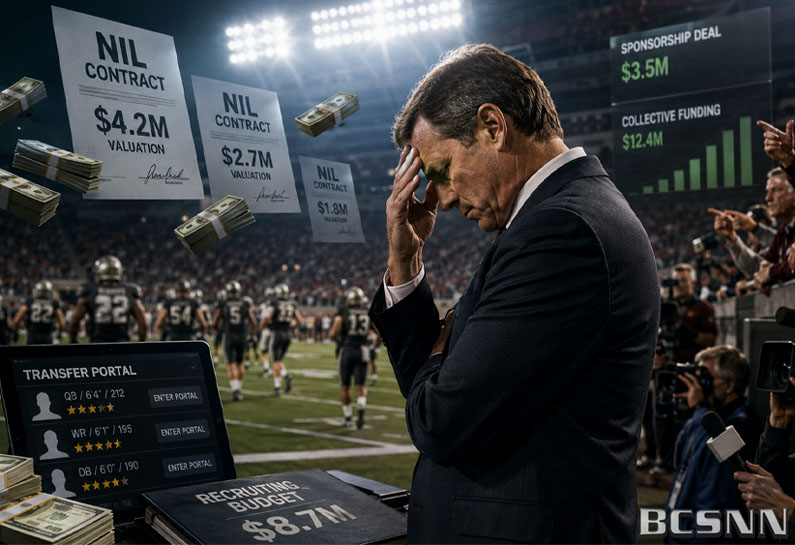
(BCSNN) -- Sitting on a panel Sunday evening alongside Texas coach Steve Sarkisian, Texas A&M coach Mike Elko and Texas Tech coach Joey McGuire, Baylor coach Dave Aranda delivered pointed remarks about the widening financial gulf in college athletics — comments that felt overdue in a sport increasingly defined by massive budgets, aggressive NIL spending and escalating competitive imbalance.
Aranda didn’t name specific programs, but with three of the sport’s biggest spenders seated beside him, his message was unmistakable.
“There’s a cap,” Aranda said, likely referring to institutional revenue share. “I think, for some of us in here, the cap is the ceiling. For others, the cap is the floor. There’s so much money moving around and kind of elbows widen out that what you’d like is for there to be rules and then you’d like the ability to enforce the rules.”
The three coaches next to him lead programs that pour enormous resources into football — and have become top transfer‑portal destinations because of it. Spend big, win big. It’s a formula that has reshaped the sport.
Aranda, who praised Baylor’s renewed NIL commitment at the same event in 2024, made clear that the landscape has changed dramatically in just a few years.
“I became a head coach in 2020 and there’s been so much change since then,” Aranda said in a video shared by Joseph Duarte of the Houston Chronicle. “Not in order, but transfer portal, NIL, agents being involved.”
Those changes have introduced new pressures for coaches trying to win games and keep their jobs. Aranda knows that reality well — he enters 2026 needing results after three losing seasons in the past four years.
His comments Sunday sounded like a push for regulation, a plea for guardrails in a sport that has spent half a decade drifting toward unchecked spending and competitive imbalance.
“The spirit of college football, we all love it, and that will always be,” Aranda said. “But the college football that was probably prior to 2020 is different than the college football that we’re in right now.”
After years of scandals, runaway budgets and a marketplace where some programs operate with limitless resources, Aranda’s call for rules — and enforcement — felt like something the sport has needed for a long time.