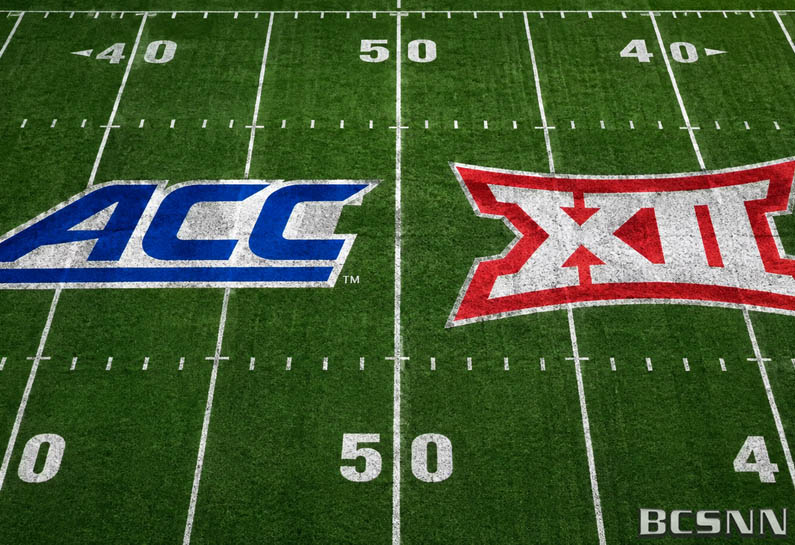
BCSNN — Looking at the current state of college football, it’s not hard to see the divide forming. The SEC and Big Ten have spent the first half of the season reinforcing what many suspected in August: they are operating in a tier of their own.
Their depth, physicality, and week‑to‑week consistency have created a clear separation from the rest of the Football Bowl Subdivision. But the more interesting development is what’s happening behind them — specifically, the widening gap between the Big 12 and the ACC, and how both compare to the Group of Six leagues.
The Big 12 and ACC entered the season with similar national perception: competitive, unpredictable, and capable of producing top‑25 teams without the overwhelming dominance of the SEC or Big Ten. But results have not treated them equally. The Big 12’s middle and upper tiers have held firm, while the ACC’s have repeatedly faltered in matchups that should have been manageable.
That contrast becomes even sharper when viewed through the lens of hypothetical cross‑conference matchups. Based on results this season, many observers — myself included — would feel comfortable betting against the ACC in a head‑to‑head format against the top G6 teams. The league’s inconsistency, especially outside its top two or three programs, has been glaring.
Meanwhile, the Big 12 has quietly built one of the strongest résumés of any league outside the SEC and Big Ten. Even with the stunning loss Oklahoma State suffered against Tulsa, the conference’s overall body of work remains impressive. The Cowboys, after all, beat Oregon, a team widely viewed as a top‑10 contender. That single data point matters when evaluating how the Big 12 stacks up against the G6.
If you created a league composed of the top 16 G6 teams, the Big 12 would likely go 15–1, 14–2, or at worst 12–4 in head‑to‑head matchups. That projection isn’t hyperbole — it’s grounded in actual results. Big 12 teams have consistently handled opponents from the American, Sun Belt, Mountain West, MAC, Conference USA, and the restructured Pac‑12. Even the league’s mid‑tier programs have shown the ability to win games they’re supposed to win, something the ACC has struggled with.
The problem isn’t talent — the ACC has plenty — but rather week‑to‑week volatility. Too many teams have been unable to string together complete performances, and too many games have swung on turnovers, stalled drives, or defensive breakdowns.
This isn’t to say the ACC is weak — only that its margin for error is thinner, and its floor is lower. Look, when Pitt and Duke are two of the three teams you're banking your Playoff hopes on, you're not in the driver's seat. At least falling flat on the field has forced Clemson and Florida State to stop throwing their weight around and threatening to take off... for now. That's the only good they've done the ACC this season.
The broader takeaway is that college football’s landscape is shifting. The SEC and Big Ten remain the sport’s juggernauts, pulling away from the pack. But beneath them, the Big 12 has emerged as the strongest of the remaining leagues, while the ACC has slipped into a precarious middle ground — too talented (and wealthy) to be dismissed, but too inconsistent to be trusted.
As the season continues, the gap may widen or narrow. But right now, the evidence is clear: the Big 12 is surging, the ACC is stumbling, and the G6 is closer to the ACC than the ACC is to the Big 12.